
Industrial Anti-Fatigue Mats for Standing Workstations
Shop anti-fatigue mats for suitable standing workstations in factories, workshops, warehouses, packing areas and other workplaces. Choose fixed-size mats, anti-fatigue matting rolls, modular systems, drainage designs and documented oil-resistant options.
Select the mat for the actual dry, wet or oily environment and compare its dimensions, thickness, material, surface, edges, cleaning method and verified resistance. Anti-fatigue matting can provide a more comfortable surface underfoot, but it does not replace a proper workstation assessment, regular movement, suitable footwear or rest breaks.
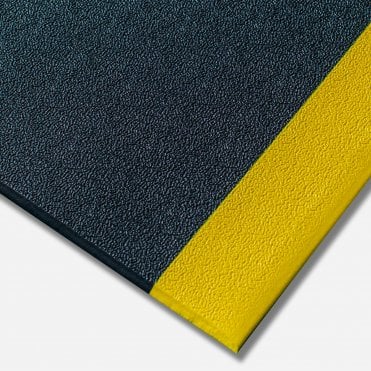
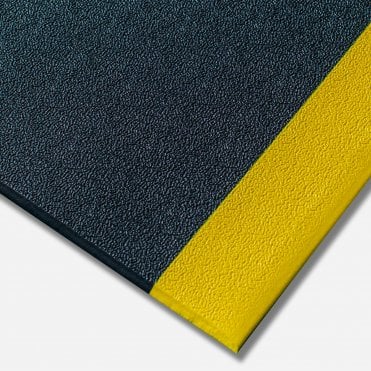
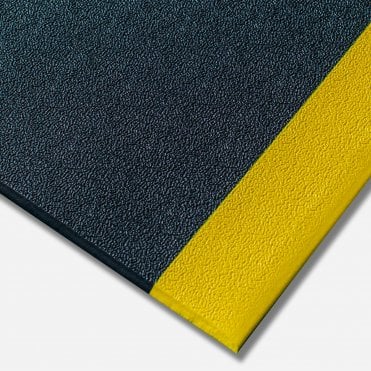
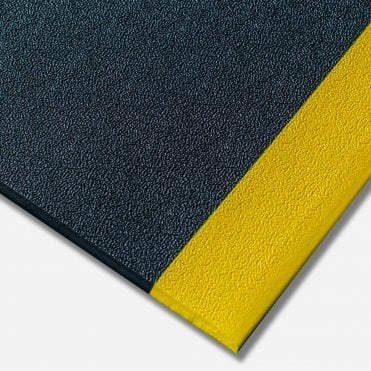
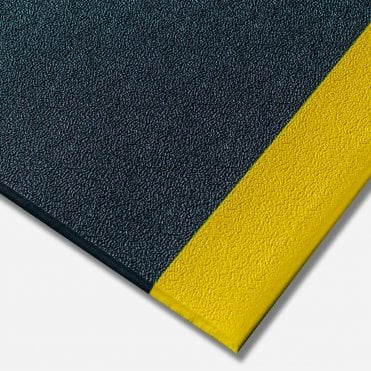
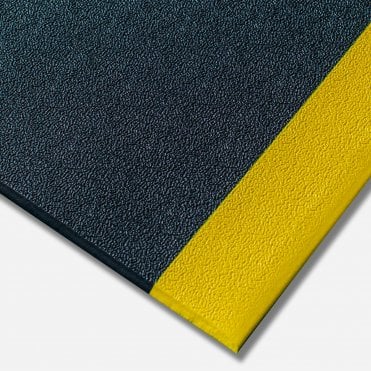
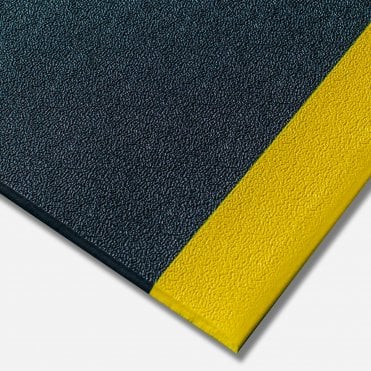
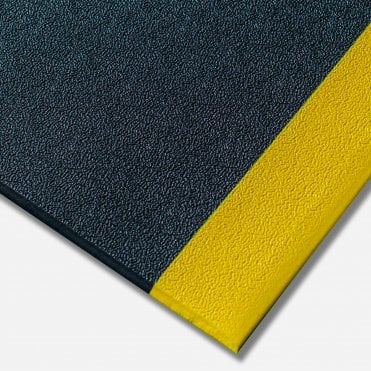
Industrial Anti-Fatigue Mats
Anti-fatigue mats provide a resilient surface for suitable workstations where people spend extended periods standing on hard floors. The On1shelf range includes fixed-size workplace mats, PVC and vinyl sponge matting, rubber drainage mats, modular interlocking systems, oil-resistant products and long anti-fatigue matting rolls.
The correct mat depends on much more than its size. Dry packing stations, wet processing areas and workstations exposed to oil or swarf require different materials, surfaces and drainage designs. Product suitability should therefore be established from the exact specification rather than from broad descriptions such as heavy duty, safety mat or non-slip.
Types of Anti-Fatigue Mat
Dry-Area Anti-Fatigue Mats
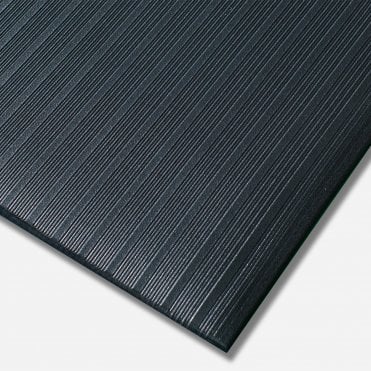
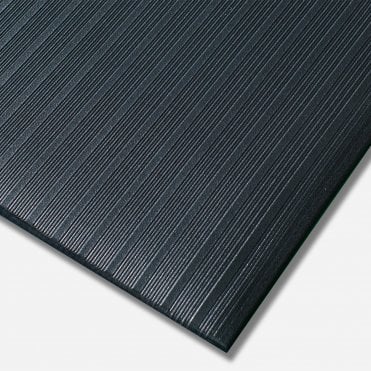
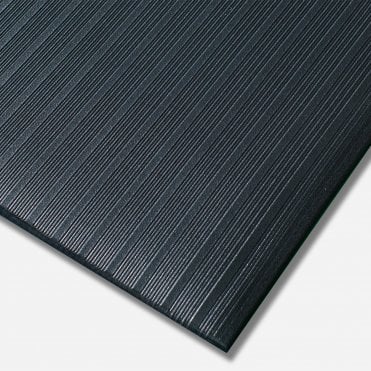
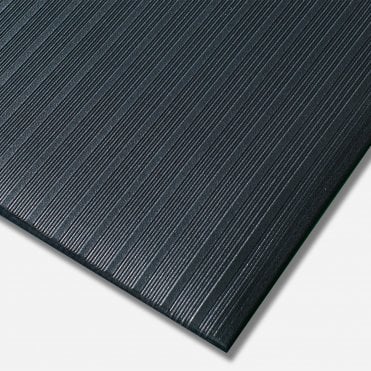
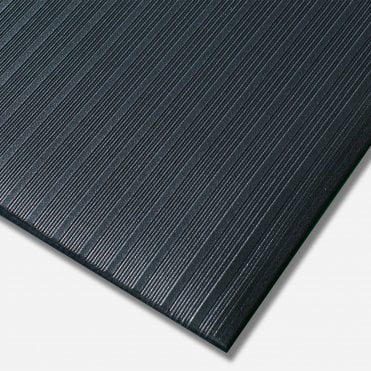
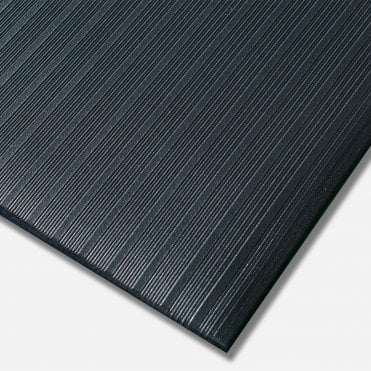
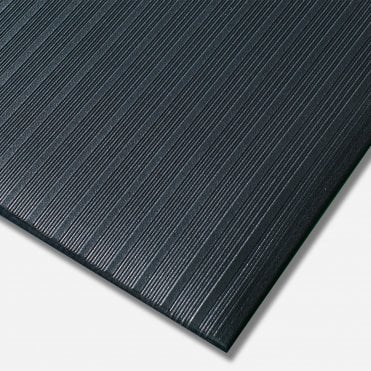
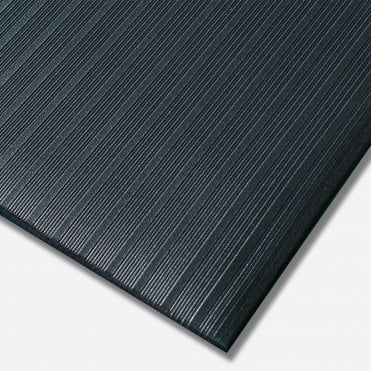
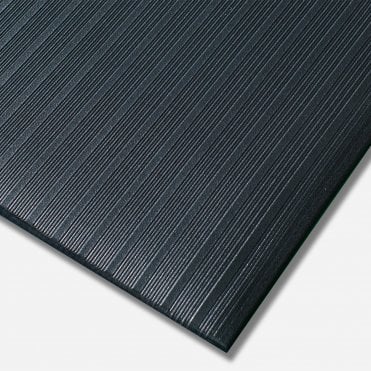
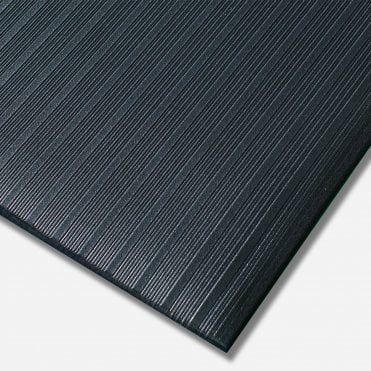
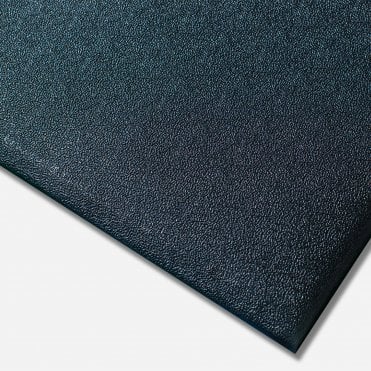
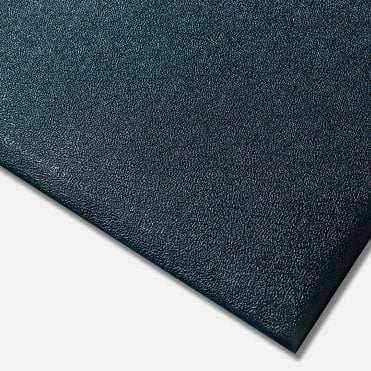
Dry-area mats commonly use closed-cell PVC sponge, vinyl sponge or layered constructions to provide cushioning at standing workstations. Surface designs within the current range include ribbed, pebble and diamond patterns.
These products may be considered for suitable packing benches, assembly stations, counters, inspection areas and workshop workstations where the floor is expected to remain dry. A dry-area classification must not be extended to wet, oily or chemically contaminated areas without supporting product documentation.
Drainage Anti-Fatigue Mats
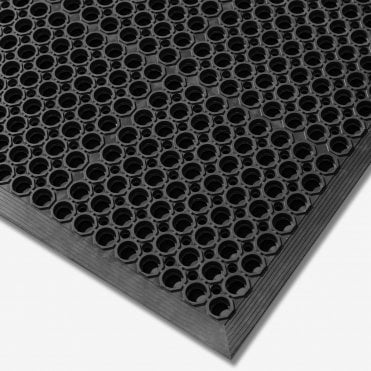
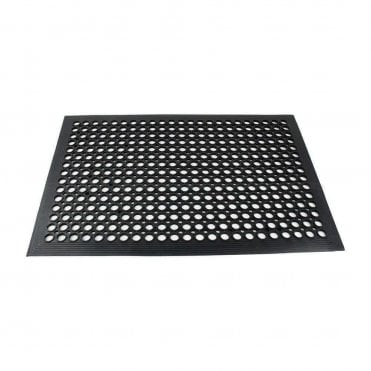
Open-top and perforated mats allow compatible liquids and small debris to pass through the walking surface. This can be useful in suitable wet work areas or locations where swarf must fall away from the operator’s standing position.
Check the drainage-hole dimensions, underside clearance and cleaning requirements. Liquids and debris still need somewhere to drain, and contamination underneath the mat must be removed regularly.
Oil-Resistant Anti-Fatigue Mats
Some mats are manufactured from compounds intended for work areas exposed to oil or grease. Oil resistance must be documented for the exact material and expected substance, concentration, temperature and exposure period.
Do not assume that a mat described as rubber, nitrile or oil resistant is compatible with every lubricant, fuel, solvent or industrial chemical. Consult the supplier’s compatibility information before specifying it for sustained exposure.
Modular and Interlocking Mats
Modular tiles and linking sections can provide larger or unusually shaped standing areas. Individual sections may also be replaced when damaged without replacing the complete installation.
Confirm the tile dimensions, connection method, available edge and corner pieces, finished thickness and whether open-top and solid-top sections can genuinely be combined. Joins should remain flat and securely connected in the intended working conditions.
Anti-Fatigue Matting Rolls
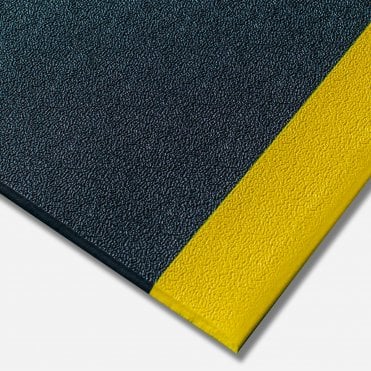
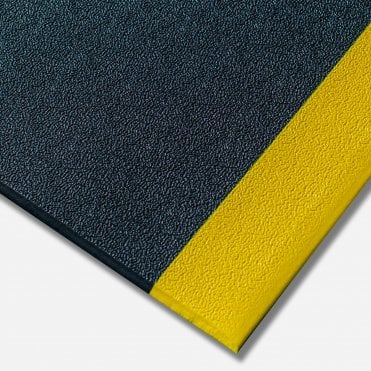
Long rolls can cover production lines, packing stations and multiple adjacent work positions. The range includes several widths and roll lengths, with black and black-and-yellow edge options available in selected families.
Check whether the product is supplied as a complete roll, a fixed cut length or matting sold by the linear metre. Confirm whether cutting is permitted and whether cut edges require finishing or bevelled edging.
How to Choose an Anti-Fatigue Mat
- Working environment: establish whether the location is normally dry, wet, oily or exposed to chemicals and debris.
- Standing area: measure the operator’s actual working movement rather than only the space directly in front of the machine.
- Material: compare the documented PVC sponge, vinyl, rubber, nitrile or composite construction.
- Thickness: check the complete mat thickness and resulting transition from the surrounding floor.
- Surface: select a ribbed, pebble, diamond, raised-nib or open drainage design appropriate to the documented environment.
- Edges: compare straight, bevelled and high-visibility edge options.
- Format: choose between a fixed-size mat, roll, cut length or modular tile system.
- Traffic: consider operator movement, pedestrian crossings and any trolleys or wheeled equipment.
- Resistance: verify any required oil, grease, chemical, temperature, fire or electrical performance.
- Cleaning: confirm that the mat can be cleaned effectively using methods compatible with its material.
Measuring the Workstation
- Measure the complete area in which the operator normally stands and moves.
- Identify foot controls, pedals, machine bases and other equipment that must remain accessible.
- Check the distance to nearby walkways, doors and emergency routes.
- Measure the available width and length at several points.
- Check the mat thickness and edge transition against the surrounding floor.
- For modular installations, calculate the number of complete centre, edge and corner sections required.
- For rolls, confirm the fixed roll width and calculate the necessary continuous length.
A mat should not be so small that the operator repeatedly steps on and off a raised edge during normal work. Equally, it should not extend unnecessarily into pedestrian or vehicle routes.
Dry, Wet and Oily Work Areas
Dry-area sponge mats are intended for locations where significant liquid contamination is not expected. They should not automatically be used beside machinery, sinks, food-processing equipment or other sources of liquid.
Wet-area products normally require suitable drainage openings and an underside that allows liquid to move away. The supporting floor must also have an appropriate drainage route; perforations in the mat alone do not remove water.
Oily environments require a mat with documented resistance to the particular oil or grease involved. A product suitable for vegetable oil may not have the same compatibility with mineral oil, hydraulic fluid, fuel or solvent.
Mat Sizes, Rolls and Modular Systems
Fixed-size mats provide a straightforward option for an individual workstation. Product dimensions should state the complete width, length and thickness, together with any integrated bevelled edge.
Roll products are better suited to long benches, production lines and multiple work positions. Titles must distinguish clearly between centimetres and metres. For example, a 60cm-wide roll with an 18.3m length must not be listed as 60cm × 18.3cm.
Modular systems should publish the installed dimensions of each section, the connection method and the available accessories. Edge and corner components should be identified separately from the main standing tiles.
Positioning and Installation
Clean the supporting floor and remove loose debris, grease and moisture before positioning the mat. Follow the product-specific instructions for unrolling, conditioning, cutting or connecting sections.
The mat should lie flat without curled corners, raised joins or unsupported edges. Avoid placing loose mats where doors, pallet trucks, machinery or other equipment can catch their edges.
Black-and-yellow edges can improve visual contrast in some surroundings, but colour alone does not establish compliance with a workplace marking or safety requirement.
Anti-Fatigue and Ergonomic Limitations
An anti-fatigue mat is only one part of workstation design. Standing work should also consider working height, reach distances, task repetition, footwear, temperature, opportunities to change posture and the amount of uninterrupted standing.
Do not describe anti-fatigue matting as preventing pain, improving circulation, correcting posture or eliminating workplace injuries without suitable evidence. Individual comfort and the effectiveness of a mat depend on the user, task, material, firmness and working conditions.
Slip and Trip Considerations
A textured surface or rubber construction must not automatically be described as non-slip. Slip performance depends on the exact surface, contamination, footwear, cleaning method and supporting floor.
The complete installation should be inspected for movement, curled edges, damaged joins and unsuitable height changes. A mat can become a trip hazard if it is incorrectly selected, positioned or maintained.
Cleaning and Maintenance
- Remove loose dirt, swarf and debris regularly.
- Clean the surface using a method compatible with the documented material.
- Lift drainage mats and clean contamination from the supporting floor.
- Inspect edges, corners, joins and modular connectors for damage.
- Check sponge products for permanent compression or delamination.
- Replace mats that remain curled, cracked, distorted or unstable.
- Reassess suitability whenever the process, contamination or workstation layout changes.
Typical Applications
Subject to the exact product specification, anti-fatigue mats may be considered for:
- Packing and dispatch stations
- Assembly and inspection workstations
- Production lines
- Workshop benches
- Machine operator positions
- Warehouse counters
- Retail and service counters
- Suitable commercial kitchens and preparation areas
- Wet or oily workplaces using a properly specified mat
These are general examples. The product specification, workplace assessment, floor, contamination, footwear and maintenance arrangements determine actual suitability.
Related Mats and Flooring
- Browse specialist industrial mats for contamination-control, hazard and other workplace matting.
- Explore catering mats for suitable food-preparation and commercial kitchen areas.
- Choose industrial rubber matting and flooring for rubber rolls, cut lengths and floor tiles.
- Shop entrance mats and door mats for dirt and moisture control at doorways.
- Use floor cable protectors for compatible temporary cable routes.
Frequently Asked Questions
What does an anti-fatigue mat do?
It provides a resilient surface intended to improve underfoot comfort at suitable standing workstations. Its effectiveness depends on the mat, task, user and working environment.
Which anti-fatigue mat is suitable for a dry workplace?
Choose a product explicitly classified for dry areas and compare its material, surface, thickness, dimensions, edges and expected traffic.
Can an anti-fatigue mat be used in a wet area?
Only where the product is documented for wet conditions. Check its drainage design, material, supporting floor and cleaning requirements.
Are rubber anti-fatigue mats oil resistant?
Not automatically. Oil resistance depends on the exact rubber compound and the particular oil, concentration, temperature and exposure period.
Can anti-fatigue matting rolls be cut?
Some rolls may be cut to length, but confirm this for the selected product. Cutting can leave unbevelled edges or affect a layered construction.
Are anti-fatigue mats non-slip?
No mat should be treated as universally non-slip. Performance depends on the tested surface, contamination, footwear, supporting floor, cleaning and installation.
What thickness should I choose?
Thickness alone does not determine comfort or suitability. Material firmness, compression, stability, edge design and the operator’s task must also be considered.
What is the difference between a fixed mat and modular matting?
A fixed mat covers one defined area. Modular sections connect to form larger or customised layouts and may use separate edge and corner pieces.
Do anti-fatigue mats replace rest breaks?
No. They are one possible workstation control and do not replace regular movement, changes of posture, suitable footwear, rest breaks or a workplace assessment.