
Cable Tie Mounts & Fixing Bases
Shop cable tie mounts and fixing bases for routing cables along walls, panels, cabinets, machinery and vehicle trim. Choose from self-adhesive bases, screw-fixing mounts, masonry anchors and cable ties with integrated push or screw mounts.
Check the compatible cable-tie width, mounting method, fixing-hole size, surface requirements and material specification before ordering.


Cable Tie Mounts and Fixing Bases
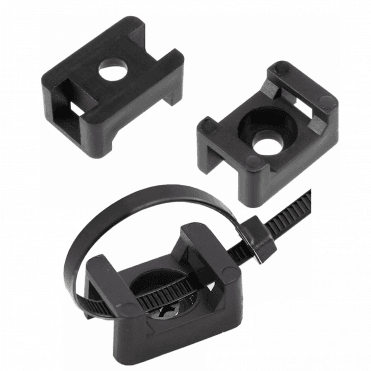
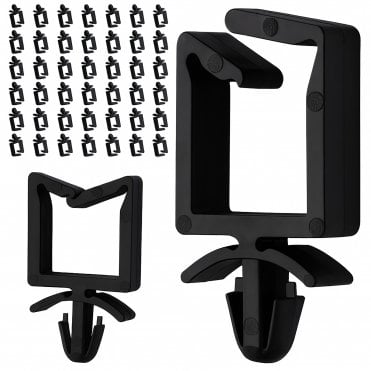
Cable tie mounts provide an anchoring point for securing cable bundles to walls, panels, cabinets, machinery and other suitable surfaces. After the mount has been installed, a compatible cable tie passes through the mounting base and around the intended cable bundle.
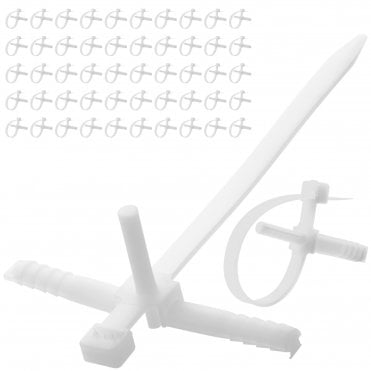
The range includes separate self-adhesive and screw-fixing bases, masonry fixing plugs and one-piece cable ties with integrated push, saddle or screw-mount heads. These products are also commonly described as cable tie bases, cable tie anchors, zip-tie mounts or cable management mounting bases.
Mounting methods are not interchangeable. Select the fixing according to the surface, cable-tie width, bundle size, installation environment and required permanence.
Choose the Correct Mounting Method
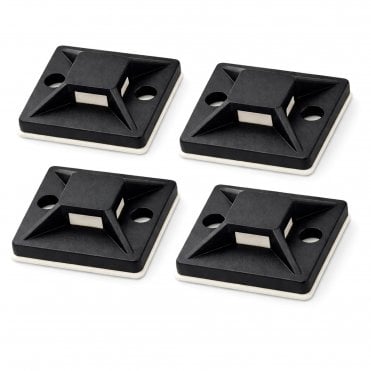
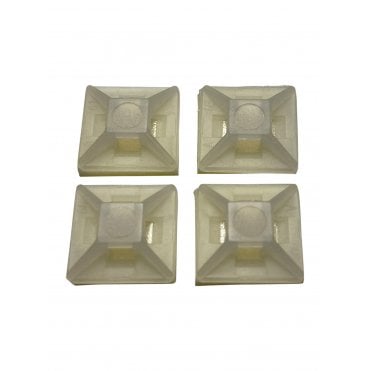
- Self-adhesive cable tie mounts: useful where drilling is undesirable and the selected adhesive is compatible with the mounting surface. They are commonly used on clean panels, cabinets and equipment housings.
- Screw-fixing cable tie bases: provide a mechanically secured anchoring point. The screw, mounting hole and surrounding material must be suitable for the installation.
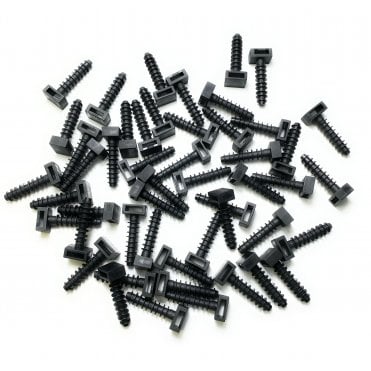
- Masonry fixing mounts: fit into a correctly sized drilled hole in a compatible solid substrate. Confirm the required hole diameter and approved material before installation.
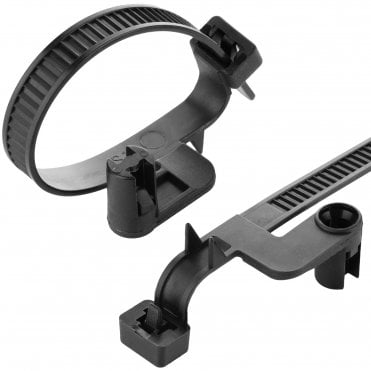
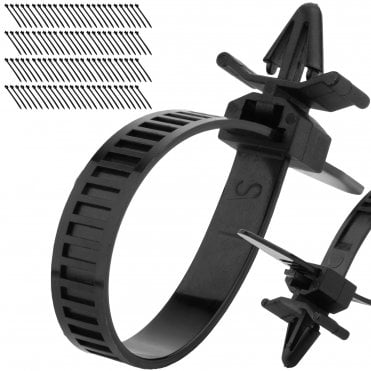
- Push-mount cable ties: combine a cable tie with an integrated panel fixing. The mounting stem or wings must match the panel-hole diameter and panel thickness.
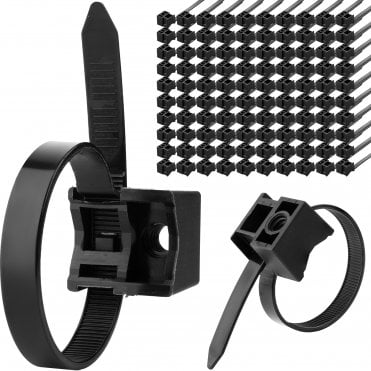
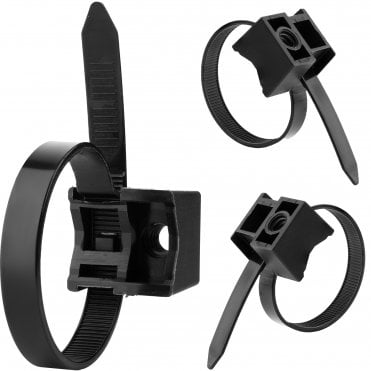
- Saddle-mount cable ties: include a fixing hole within the cable-tie head or saddle, allowing the tie and bundle to be attached using a suitable screw or fastener.
- Expandable plug cable ties: use an integrated expanding anchor designed for a specified hole and substrate. They do not require a separate mounting base.
Self-Adhesive Cable Tie Bases
Self-adhesive mounts provide a convenient cable-routing point without immediately drilling into the surface. Four-way entry designs allow the cable tie to be inserted from different directions, making it easier to route cables vertically or horizontally.
Adhesive performance depends heavily on the adhesive system and mounting surface. A mount that bonds well to smooth metal may perform differently on textured paint, dusty masonry, flexible plastic or a low-energy plastic surface.
Before installation, confirm that the surface is:
- Clean, dry and free from dust, oil, polish and loose material
- Compatible with the mount's documented adhesive
- Within the stated application-temperature range
- Flat enough to provide proper contact across the adhesive pad
Apply firm, even pressure and follow the individual product instructions before loading the mount. Do not assume that every adhesive mount can carry a cable bundle immediately or that all adhesive systems require the same curing time.
Where a mount includes a central fixing hole, a suitable screw may provide additional mechanical retention. Do not describe this as guaranteed extra strength unless the mount and screw installation have been specified for that purpose.
Screw-Fixing Cable Tie Mounts
Screw-mounted bases are useful where a more permanent mechanical fixing is required or where the surface is unsuitable for adhesive. They are commonly fitted to timber, equipment panels, enclosures and compatible structural surfaces.
Select the screw or bolt according to the fixing hole, surface material and expected installation conditions. The product pack may not include screws unless this is clearly stated on the individual product page.
Do not overtighten the fastener. Excessive tightening can distort or crack a nylon mounting base, reducing its ability to retain the cable tie correctly.
Masonry and Wall-Mount Fixings
Masonry cable tie mounts and expandable plug ties require a correctly positioned hole of the specified diameter. Drill only after checking for concealed cables, pipes and other services.
The words “wall mount” do not establish suitability for every wall construction. Solid masonry, hollow block, plasterboard, timber and sheet materials require different fixing designs. Check the approved substrate, hole diameter and installation method for the selected product.
Remove loose drilling dust before inserting a masonry fixing. A poorly drilled, oversized or damaged hole can reduce the security of the mounting point.
Push-Mount and Panel-Mount Cable Ties
Push-mount cable ties combine cable bundling and panel attachment in one component. Their integrated fixing is inserted into a compatible panel or chassis hole, helping secure wiring looms without requiring a separate mounting base.
Compatibility depends on more than the cable-tie length. Check:
- Required panel-hole diameter
- Compatible panel thickness
- Mounting-head or wing design
- Cable-tie dimensions
- Maximum bundle diameter
- Whether the panel fixing or cable tie is releasable
A fixing that can be removed from the panel is not automatically a reusable cable tie. The strap must also include a purpose-made release mechanism if the bundle needs to be opened without cutting the tie.
Check Cable-Tie Compatibility
Separate mounting bases have a maximum cable-tie width that can pass through their entry slots. A mount designed for a narrow 3.6 mm tie may not accept a 4.8 mm, 7.6 mm or 9.0 mm tie.
Check the maximum compatible strap width rather than relying only on the overall dimensions of the mounting base. The cable tie should pass through the entry smoothly without being forced, folded or damaged.
Also confirm that the selected tie provides sufficient length for the cable bundle after passing through or around the mount.
Mount Strength and Cable-Tie Strength
The strength of a cable tie does not determine the strength of the complete mounted installation. Performance can be limited by the mounting base, adhesive, screw, anchor, panel, drilled hole or underlying surface.
Do not apply the tensile-strength figure of a cable tie to the complete fixing assembly. Mount pull-off strength and cable-tie loop tensile strength are different measurements and must be verified separately for the exact products.
Vibration, heat, moisture, ultraviolet exposure, chemicals, surface contamination and ageing may also affect the installation. Replace any mount or cable tie showing cracking, movement, adhesive separation or other damage.
Common Applications
- Routing cables inside electrical cabinets and enclosures
- Organising wiring behind desks and entertainment equipment
- Securing wiring looms to suitable vehicle panels
- Managing cables inside machinery and equipment
- Routing network, telecommunications and data cables
- Securing suitable lightweight hoses and tubes
- Organising workshop and garage wiring
- Temporary installation and prototype cable routing
These are general examples rather than universal product approvals. Cable tie mounts must not be used as lifting equipment, fall protection, structural supports or certified load restraints.
How to Install a Cable Tie Mount
- Select the correct mount for the surface and cable-tie width.
- Plan the cable route and mark each fixing position.
- Check for hidden cables, pipes and obstructions before drilling.
- Prepare the surface or mounting hole according to the product instructions.
- Install the adhesive, screw, masonry or push fixing without damaging the mount.
- Feed a compatible cable tie through the fixing point.
- Position the cable bundle and tighten the tie gradually.
- Avoid crushing cable insulation or placing excessive strain on the mount.
- Trim the surplus cable-tie tail safely where required.
- Inspect the completed route and confirm that every mount remains secure.
Related Cable-Tie Products
- Use standard nylon cable ties with compatible fixing bases for everyday cable routing.
- Choose heavy-duty cable ties only after confirming that the mount and surface can support the intended installation.
- Choose releasable cable ties where the cable bundle must be opened or adjusted.
- Visit special cable ties for integrated mounting heads, identification features and specialist constructions.
Frequently Asked Questions
What are cable tie mounts used for?
They create an anchoring point that allows a cable tie and its bundle to be secured to a suitable wall, panel, cabinet or item of equipment.
Are adhesive cable tie mounts permanent?
Not necessarily. Their performance depends on the adhesive, surface preparation, temperature, load and environment. Use a screw-mounted product where the installation requires a documented mechanical fixing.
Can adhesive mounts be used on painted walls?
Only when the adhesive is suitable for the paint and the paint is securely bonded to the surface. Removing the mount may damage or lift the finish.
Do cable tie fixing bases include cable ties?
Not always. Separate mounting bases may be supplied without cable ties, while push-mount and saddle-mount ties combine the strap and fixing. Check the product title and pack contents before ordering.
What cable-tie width fits the mount?
Each mount has a maximum compatible strap width. Check the individual specification because a slot intended for a 3.6 mm tie may not accept a wider cable tie.
Are push-mount cable ties reusable?
Only when the strap has a purpose-made release mechanism. The ability to remove the fixing from a panel does not automatically make the cable tie itself reusable.
Can cable tie mounts be used outdoors?
Only when the mount material, adhesive or mechanical fixing is documented as suitable for the expected outdoor conditions. Black colour alone does not prove ultraviolet resistance.
Are cable tie mounts suitable for heavy cables?
That depends on the complete installation, including the mount, cable tie, fastener, surface and environment. Do not calculate the installation capacity from cable-tie tensile strength alone.