
Floor Cable Protectors & Cable Covers
Shop floor cable protectors and cable covers for organising and covering trailing cables across suitable indoor floors. Choose from low-profile flexible PVC covers and larger rubber protectors, with different channel sizes, colours and lengths available.
Measure the complete cable bundle and check the channel dimensions, overall profile, material, length and documented traffic rating before ordering. Do not assume that every floor cable protector is suitable for vehicles, outdoor use or heavily trafficked walkways.
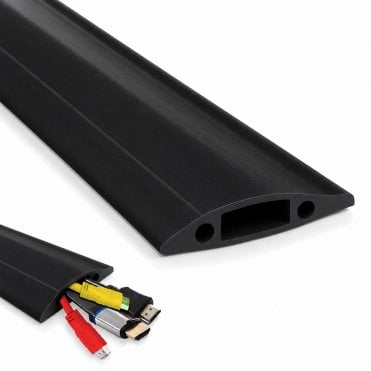
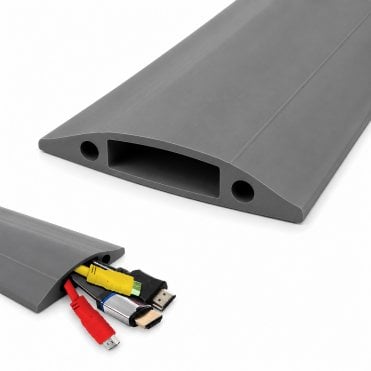
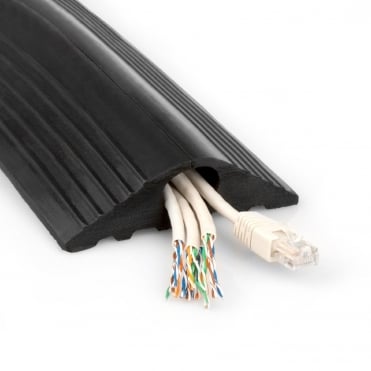

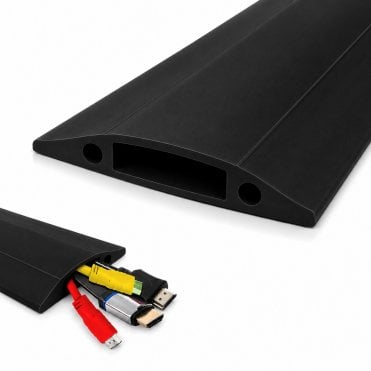
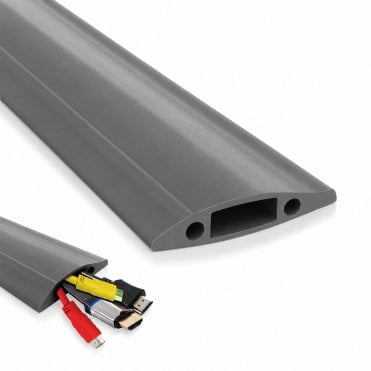
Floor Cable Protectors and Cable Covers
Floor cable protectors provide a defined route for compatible power, data, audio and other cables that must temporarily cross a suitable floor. The protector covers the cable and reduces direct contact from normal pedestrian movement when it is correctly selected, positioned and maintained.
The current On1shelf range includes flexible PVC floor cable covers and larger rubber cable protectors. These products differ in profile size, channel capacity and intended application, so they should not be treated as interchangeable.
Types of Floor Cable Protector
Low-Profile PVC Cable Covers
Flexible PVC cable covers provide a lower-profile option for suitable homes, offices, meeting rooms, exhibitions and other indoor pedestrian areas. The current range includes black and grey covers with 16mm × 8mm and 30mm × 10mm internal cable channels.
Check whether the stated measurement refers to the internal cable channel or the complete external profile. A 30mm-wide cable channel does not mean that the complete floor cover is only 30mm wide.
Rubber Cable Protectors
The larger black rubber protectors provide more internal space for compatible cables and cable bundles. Current designs include a narrower single-channel profile and a wider multi-channel profile.
A larger or heavier rubber construction must not automatically be described as vehicle rated or suitable for industrial traffic. Where vehicles, pallet trucks, trolleys or other equipment will cross the protector, obtain a documented load rating and operating conditions for the exact product.
Single-Channel and Multi-Channel Protectors
A single-channel protector keeps compatible cables together within one cavity. A multi-channel protector separates cables into several routes, which may be useful where different cables must remain organised or where one large cavity would be unsuitable.
Count every cable and measure its maximum outside diameter, including connectors where they must pass through the channel. Do not estimate capacity solely from the number of cables shown in a product photograph.
How to Choose a Floor Cable Cover
- Cable dimensions: measure the outside diameter or complete width and height of the cable bundle.
- Channel dimensions: check the usable internal width, height or diameter rather than the external protector size.
- Number of channels: decide whether the cables can share one cavity or should be separated.
- Overall profile: check the protector’s complete width and maximum height against the intended route.
- Material: choose between the available flexible PVC and rubber constructions.
- Length: measure the entire exposed cable route rather than covering only its most visible section.
- Colour: consider visibility and how the protector contrasts with the surrounding floor.
- Traffic: establish whether the area has occasional pedestrian use, frequent foot traffic, trolleys or vehicles.
- Floor surface: confirm suitability for the actual carpet, tile, concrete, wood or other supporting surface.
- Environment: verify any required outdoor, ultraviolet, temperature, moisture or chemical resistance.
- Installation: check whether the protector is supplied as one continuous length, joined sections or a cuttable profile.
Measuring Cable Channel Capacity
- Count the cables that must travel through the protector.
- Measure the maximum outside diameter of each cable.
- Arrange the cables in the intended formation without crushing or sharply bending them.
- Measure the complete width and height of the resulting bundle.
- Compare those measurements with the protector’s usable internal channel dimensions.
- Check the cable manufacturer’s minimum bend radius, particularly near entry and exit points.
- Allow sufficient space to install and remove the cables without damaging their outer insulation.
Channel descriptions must use one consistent measurement method. Rectangular cavities should normally be stated as internal width × internal height, while circular cavities should use the actual internal diameter.
Choosing the Required Length
Measure the complete section where the cables are exposed at floor level. Covering only part of a trailing cable may leave another section vulnerable to contact, movement or damage.
Confirm whether the selected length is supplied as one continuous piece or as several sections. Where sections are described as linkable, check the connection method and whether the joins remain level on the intended floor.
Some flexible profiles may be cut to length, but this must be confirmed for the exact product. Cutting may affect connectors, finished ends or the protector’s ability to remain securely positioned.
Positioning and Installation
Where practical, cables should first be routed away from walkways. Where a floor-level route is necessary, position the protector across the shortest practical crossing and avoid doorways, stairs, emergency routes and other unsuitable locations.
The supporting floor should be clean, dry, stable and free from loose debris. Uncoil flexible covers and follow any documented flattening or conditioning instructions before use.
Lay the protector flat without curled ends, raised joins or unsupported edges. Avoid stretching the profile during installation because it may contract or move afterwards.
Do not trap damaged, overheating or unsuitable cables beneath a protector. A cable cover provides mechanical covering; it does not repair damaged insulation or establish electrical safety.
Pedestrian and Vehicle Traffic
Low-profile PVC covers should be treated as pedestrian cable-management products unless a different traffic classification is documented. Do not permit vehicles, pallet trucks or heavily loaded trolleys to cross them without explicit approval from the manufacturer.
A product described as heavy duty should publish a measurable load rating, test method, contact area, operating temperature and permitted traffic type. One maximum-load number without test conditions is insufficient for selecting a workplace cable ramp.
In access routes used by wheelchairs, mobility aids or wheeled equipment, check the complete height, gradient, width, edge design and documented accessibility information. A sloped profile is not automatically wheelchair accessible.
Trip-Risk Limitations
A cable protector can form part of managing trailing cables, but it does not make every cable route risk-free. The protector itself must not move, curl, create an unsuitable height change or become hidden against the surrounding floor.
Assess the complete route, lighting, visibility, pedestrian direction, footwear and expected traffic. Highly trafficked or safety-critical areas may require a different cable route or professionally specified protection.
Inspection and Maintenance
- Check that the protector remains flat and correctly positioned.
- Inspect joins, ends and cable entry points for movement or damage.
- Remove dirt and liquids using a cleaning method compatible with the documented material.
- Inspect the enclosed cables for crushed, cut, overheated or damaged insulation.
- Replace protectors with cracks, permanent curling, distorted channels or damaged connections.
- Reassess the installation whenever cables, traffic conditions or the surrounding layout change.
Typical Applications
Depending on the exact product specification, floor cable covers may be considered for:
- Home offices and workstations
- Meeting and conference rooms
- Exhibitions and temporary displays
- TV, audio and entertainment equipment
- Retail and reception areas
- Studios and suitable event spaces
- Workshops with controlled pedestrian routes
- Temporary power and data cable installations
These are general examples. The exact protector, cable type, installation and traffic conditions determine suitability.
Related Cable Management and Flooring
- Browse cable management products for desk, television and home-office cable organisation.
- Explore industrial rubber matting and flooring for floor-covering rolls, cut lengths and tiles.
- Choose cable conduit and accessories for compatible enclosed cable routes.
- Shop cable clips for securing suitable cables away from floor-level routes.
Frequently Asked Questions
What is the difference between a cable cover and a cable ramp?
A cable cover normally refers to a lower-profile product for pedestrian areas. A cable ramp is generally a larger protector intended for more demanding crossings. The product’s documented traffic and load rating matters more than the name used.
Which cable channel size do I need?
Measure the complete cable bundle and compare its maximum width and height with the usable internal channel dimensions. Leave enough room to install the cables without crushing or sharply bending them.
Can floor cable protectors be driven over?
Only where the exact product has a documented vehicle-load rating and is approved for the expected vehicle type, speed, wheel load and operating surface.
Can these cable covers be used outdoors?
Only where the exact material is documented for the expected ultraviolet exposure, moisture, temperature and duration of use.
Can a floor cable cover be cut?
Some flexible profiles may be cut, but this must be confirmed for the selected product. Cutting can remove finished ends or affect a linkable connection.
Does a cable protector completely prevent trips?
No. It can help manage a necessary floor-level cable route, but the protector must remain visible, flat, stable and suitable for the expected traffic.
Is a rubber cable protector electrically insulating?
Do not assume so. A rubber or PVC cover provides mechanical protection unless a specific electrical performance standard and test result are documented.
Can several cables share one channel?
Only when the complete bundle fits without crushing, overheating or exceeding the cables’ minimum bend radius. Check the usable internal channel dimensions.